
Tree Disease • Central Texas
Hypoxylon Canker
A fungus that does not attack healthy trees. It waits for an oak to be weakened by drought, heat, or injury, then moves into the dying sapwood and finishes it. By the time the bark sloughs off and the pale crust shows, the tree is usually already far along.
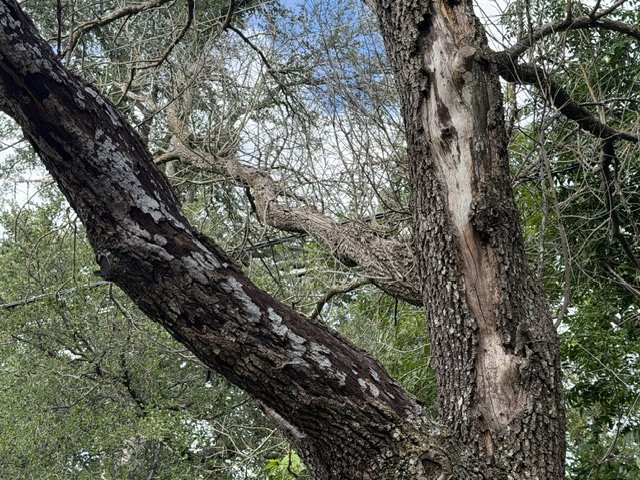

What it is
An opportunist, not an aggressor
Hypoxylon canker is caused by the fungus Biscogniauxia atropunctatum, now reclassified out of the old Hypoxylon genus that still gives the disease its common name. Its spores are already everywhere in the Central Texas environment, but a healthy, vigorous tree fights them off. It is a secondary, opportunistic pathogen: it only takes hold in the sapwood of a tree that is already stressed, injured, or in decline, oaks most often, but pecans, elms, and sycamores too.
Once it is established it decays the wood, kills the tree, and forms a crusty fungal layer on the surface that releases new spores. That is why hypoxylon is best read as a symptom. It is the messenger telling you the tree was already in serious trouble.
Biscogniauxia atropunctatum (formerly Hypoxylon atropunctatum)
How it works
Dormant for years, then it wakes
The fungus is already inside most healthy hardwoods, waiting. What changes is not the fungus, it is the tree. Here is the switch from harmless passenger to killer.
It already lives there
Biscogniauxia is a latent endophyte, riding harmlessly in the inner bark and sapwood of healthy oaks, pecans, and other hardwoods. At a normal wood moisture content of 120 to 160 percent (Texas A&M Forest Service), a vigorous tree walls it out.
Stress drops the moisture
Drought, heat, construction damage, soil compaction, or root rot pull the wood's moisture below that healthy range. With its defenses down, the tree can no longer hold the fungus in check.
It invades the sapwood
The fungus wakes, invades, and decays the sapwood from the inside. Now the decline shows above ground: a yellowing or thinning canopy, branch dieback, and water sprouts (epicormic shoots) breaking out along the trunk and limbs.
A caution worth keeping: yellowing leaves, a thinning crown, and water sprouts mean a tree is under serious stress, they are not proof of hypoxylon on their own. The fungus is confirmed only once the bark sloughs and the crusty stroma shows, or by lab diagnostics. Read these signs as a reason to look closer, not a diagnosis.
Why it shows up
It follows stress, every time
Hypoxylon is the consequence, not the cause. Something weakened the tree first, and in Central Texas that is most often water stress, our long droughts and relentless heat. These are the triggers I see most, frequently stacked on top of each other.
Prolonged water stress
Our long droughts and brutal summers push oaks past their reserves. A tree running on empty cannot wall the fungus out.
Root and grade damage
Compaction, trenching, raised soil, and paving over the root zone choke the roots that keep the canopy alive.
Construction and injury
Bulldozer scrapes, careless cuts, and fill from a new build are classic triggers that open the door to decline.
How to spot it
What hypoxylon looks like
The signs are easy to miss until the bark starts coming off. By then the fungus is well established underneath.
Canopy thinning and dieback
Yellowing, sparse leaves, and dead branches in the upper crown, often on one side first, signal the tree is failing.
Bark sloughing off
Patches of bark fall away from the trunk and large limbs, the single most recognizable sign, exposing the wood beneath.
The crusty stroma
A hard, crusty fungal layer coats the exposed wood. As it matures it darkens, and it sheds spores that ride the wind.
From the field
Reading a dying pecan in central Austin
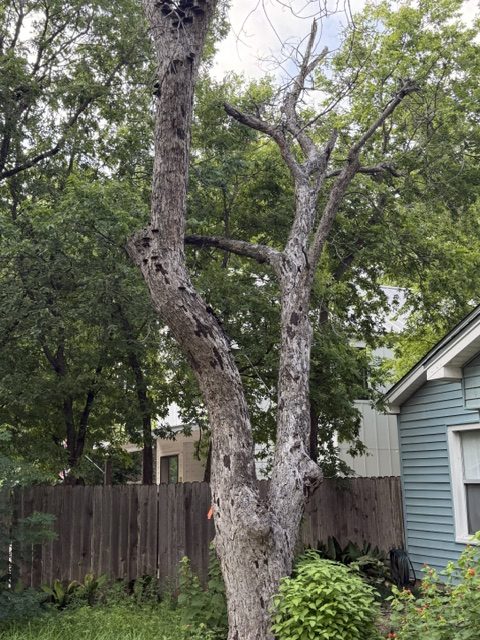
It is not only oaks. This pecan stands a few feet off the front porch of an Austin home, and it shows the same story end to end. Here is how I read it on site, in the order the evidence comes at you.
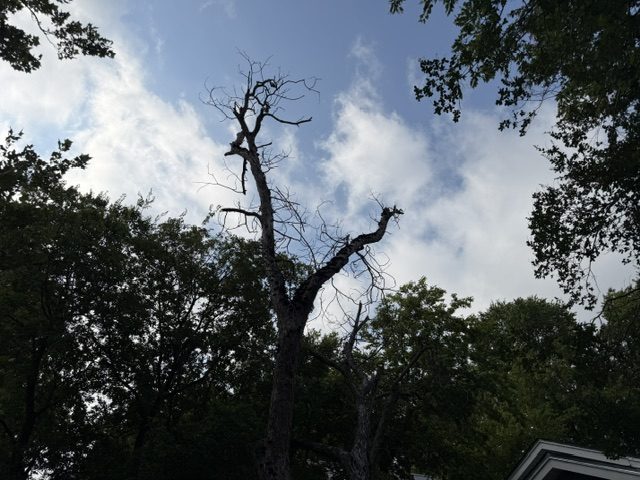
Dead up top, green all around
The whole upper canopy is bare and brittle while every tree behind it is in full leaf. This pecan is not stressed, it is finished.
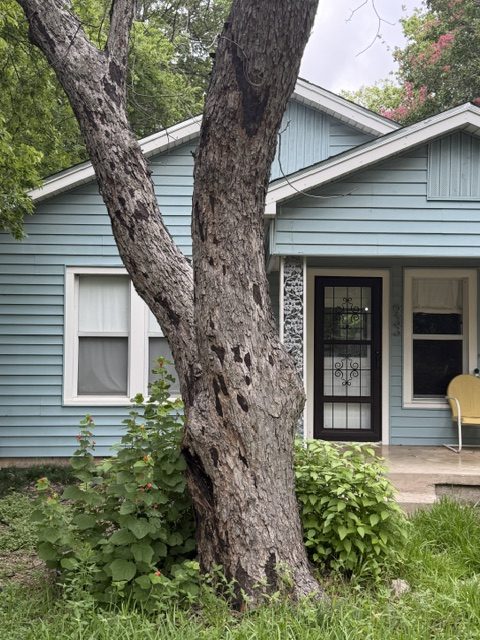
Bark sloughing, wood opening up
Bark is letting go in patches and the exposed wood is checking and cavitied. That is the surface telling you the sapwood underneath has already failed.
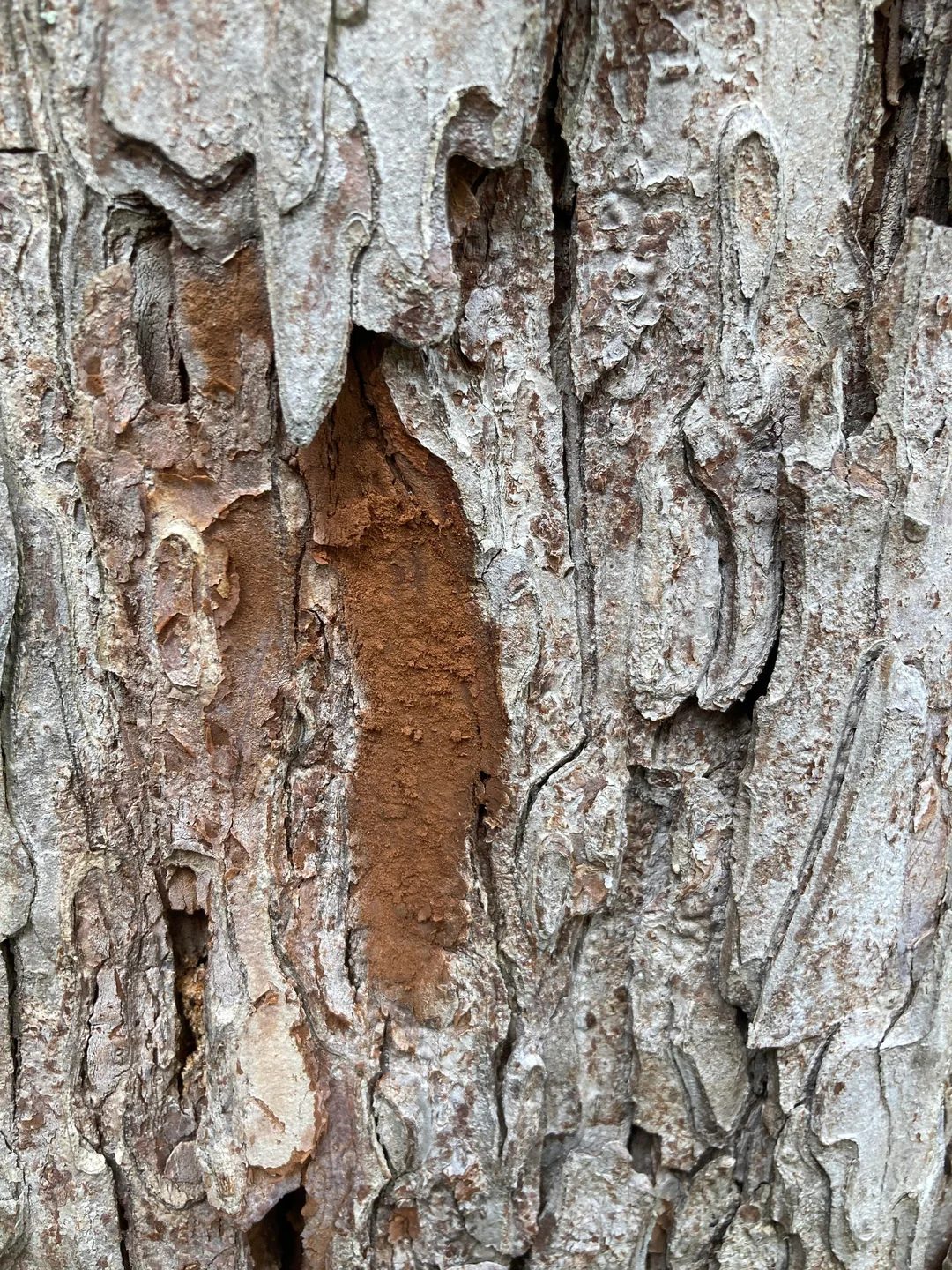
Bark giving way, wood laid bare
Up close, the gray plates lift off and the inner wood is exposed and punky. Bark letting go like this is the tree telling on itself, the failed sapwood reaching the surface.
Leaning over the front door
A codominant, decaying stem leaning straight over the porch, the door, and a chair people use. Whatever the label on the fungus, this is the reason to act.
The call: stress-driven decline, consistent with hypoxylon
Dead crown, sloughing bark, and a stress-prone pecan through back-to-back Texas droughts all point the same direction. I read this as opportunistic decline consistent with hypoxylon canker, the same opportunist covered above, here on a pecan rather than an oak. A tight look at the crust under a sloughed patch would confirm it, but the management answer does not wait on a lab: a dead, decaying stem leaning over an occupied porch is a removal, and the sooner the safer.
What it means
A late-stage problem, and a safety one
Once hypoxylon is visibly active in the wood, there is no cure. No spray or injection brings the tree back. In practice, a confirmed canker usually means the tree is already in advanced, often irreversible decline.
It is also a safety issue. The fungus decays sapwood fast, so an affected tree loses strength quickly and can fail with little warning. Trees killed by hypoxylon are dangerous to climb or work, which is why a hazard tree over a house, drive, or play area needs attention sooner rather than later.
This is a risk-assessment call
A dead or dying tree near a target is exactly what a documented tree risk assessment is for: rating the hazard and deciding, on the evidence, whether it stays or comes down.
See tree risk assessment →What to do
Protect the trees you can still save
You cannot cure a tree that already has it, but you can protect the stressed oaks around it, and handle the affected one safely.
Do
- Water deep and mulch stressed oaks through heat and drought, the single best defense is a vigorous tree.
- Protect the root zone from compaction, fill, and trenching, especially around construction.
- Get a risk assessment on an affected tree that stands over a target.
- Remove a hypoxylon-killed tree promptly, the decayed wood only gets more dangerous.
Never
- Expect a spray or injection to cure it. There is no chemical control once it is active.
- Climb or rig a hypoxylon-killed tree like a sound one, the wood can let go without warning.
- Ignore the underlying stress on nearby oaks, that is what invites it in.
- Panic that it spreads like oak wilt. It does not move tree to tree the same way and is not reportable.
Bark peeling off a struggling tree? Let's look
Send me what you are seeing and where the tree stands relative to the house or drive. I will tell you straight whether it needs an on-site assessment and how urgent it is.
This page is educational and does not diagnose any tree. Symptoms consistent with hypoxylon canker should be confirmed by an on-site evaluation and, where needed, laboratory diagnostics. Unlike oak wilt, hypoxylon canker is not a regulated or reportable disease in Texas. It is managed through stress reduction and risk mitigation, not quarantine or reporting.