Whole-tree failure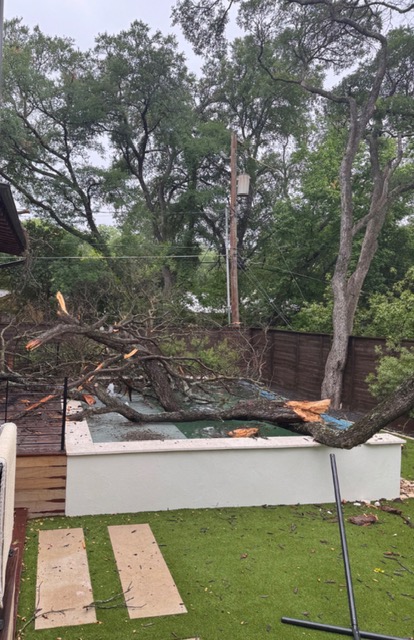
A whole tree in the pool
Root or base failure can drop an entire tree at once. Here it landed across a pool and into the utility lines, the worst-case mix of high likelihood and high consequence.

Austin, TX • TRAQ Qualified
A structured, signed evaluation of whether a tree is safe to keep or a hazard you need to act on. The kind insurers, HOAs, cities, and attorneys actually accept. You get a clear finding, a risk rating, and a recommendation you can act on or hand to a third party. Serving Austin and the surrounding Central Texas counties.

What it is
A tree risk assessment is a systematic evaluation of three things: how likely the tree or a part of it is to fail, how likely it is to hit something or someone if it does, and how serious the consequences would be. I assess to the ISA Tree Risk Assessment Qualification (TRAQ) method, the industry standard recognized by insurers and courts.
The output is not "looks fine to me." It is a documented, defensible risk rating, tied to a specific time frame, that you can put in front of an insurer, a board, a city, or an attorney with confidence.
Why it matters
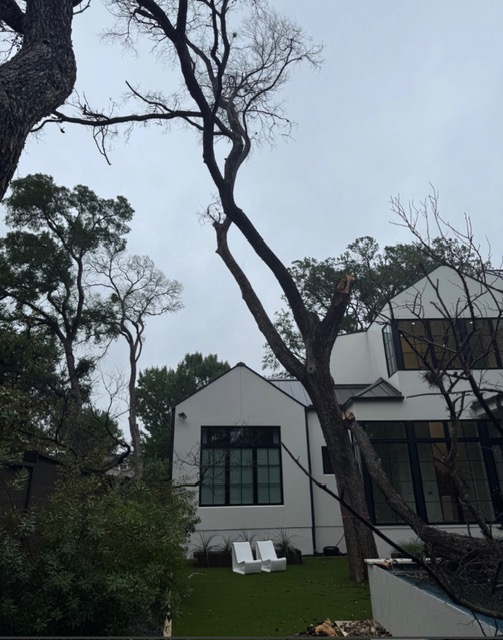
These are real photos from a single Central Texas property after one storm. Each one is the kind of failure a risk assessment is designed to catch in advance, while there is still time to act.
Root or base failure can drop an entire tree at once. Here it landed across a pool and into the utility lines, the worst-case mix of high likelihood and high consequence.
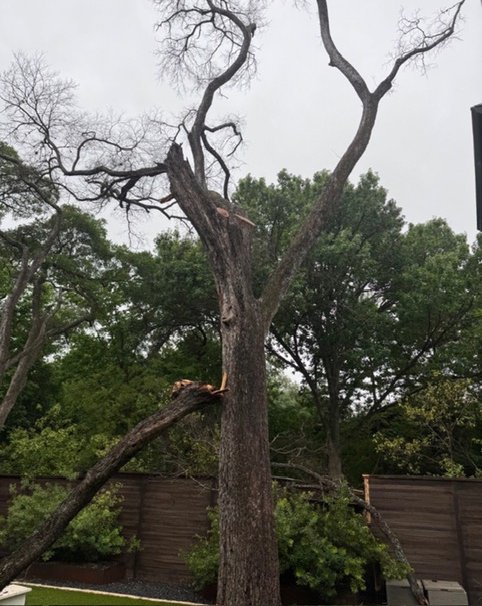
A snapped leader and a failed scaffold limb on a single tree. Defects like included bark and old wounds concentrate stress at the exact points that give way under load.
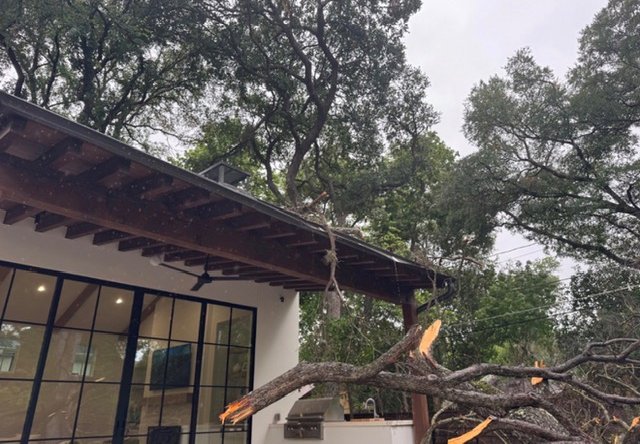
You do not need the whole tree to fail to do real damage. A single overextended limb over a roof or patio is a target waiting to be hit.
Real Central Texas site, photographed after a single storm event. These are outcomes, not diagnoses. A risk assessment is the on-site evaluation that gets ahead of them.
The hidden defect
This scaffold limb looked solid from the driveway. Inside, a column of decay had quietly hollowed it out until the shell that was left could not hold the load. By the time rotten wood is showing, the strength is long gone. Finding it first is exactly what an assessment is for.
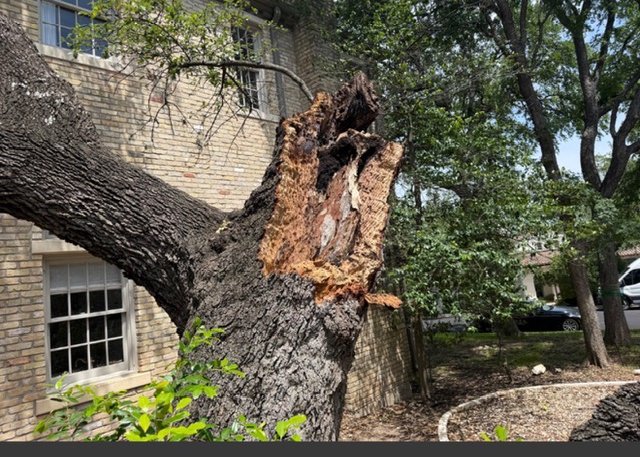
The failure tore open a cavity of advanced rot at the branch union, feet from the windows below. From the ground, the limb read as healthy.
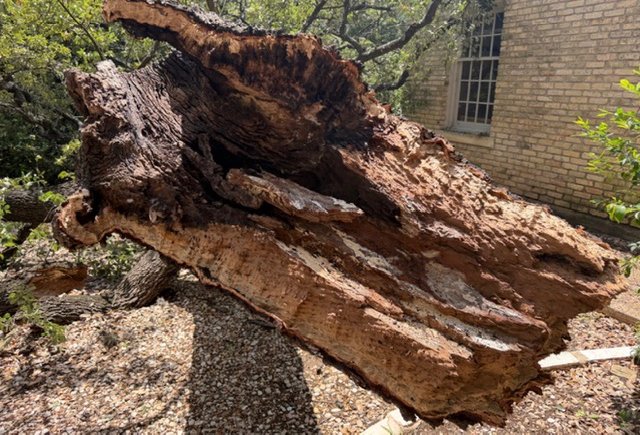
On the ground you can see how far it traveled. Punky, crumbling wood end to end, the kind of hidden defect a Level 3 decay check is built to catch.
A Central Texas pattern
Cedar elm is everywhere in Central Texas, and it has a habit: it grows tight, codominant unions with bark trapped inside them. Those unions look solid but have little real wood holding them together, so they tear out under wind, ice, or their own weight, often straight toward the house below.
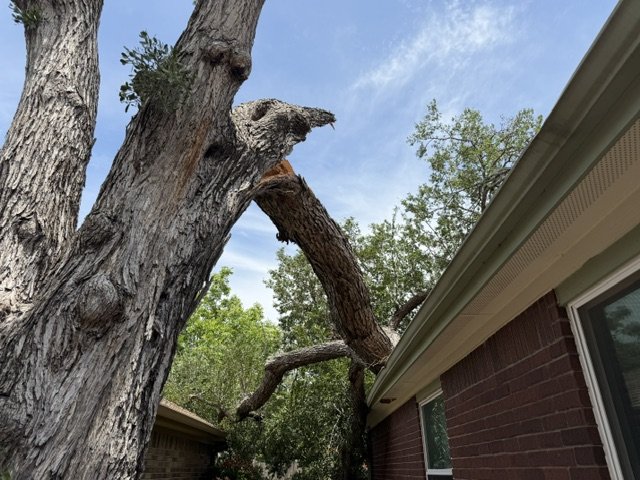
The limb tore loose at the union and hung up over the roofline, one gust away from coming down on the house.
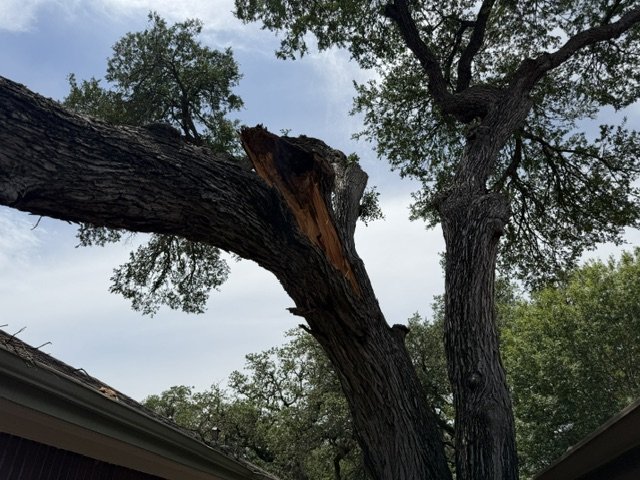
The fresh splinter shows the giveaway: bark was trapped inside the union, so there was never enough sound wood to hold the load.
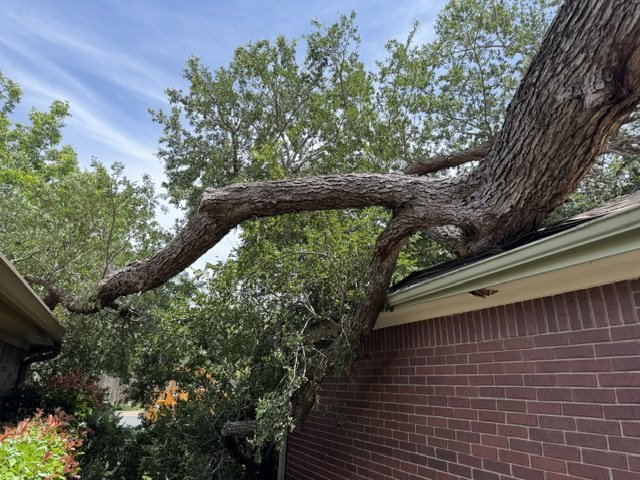
A long, heavy limb reaching out over the roof is a target waiting to happen. Catching the weak union first is the whole point of an assessment.
Real Central Texas cedar elms. Included-bark unions like these are routine here and are exactly the defect a basic Level 2 assessment is built to flag before it fails.
How it is done
The ISA and ANSI A300 standard defines three levels. I match the level to the question, so you pay for the depth the situation actually needs.
A fast visual check, often across many trees, to flag the ones that need a closer look. Useful for large properties, portfolios, and quick triage after a storm.
A complete 360-degree, ground-based inspection of the tree, its defects, the site, and the targets around it. This is the assessment behind a defensible written report.
Specialized testing where it is warranted: resistance drilling, decay detection, and root or aerial inspection to resolve what a ground-level look alone cannot confirm.
Level 3, advanced testing
When a basic visual inspection leaves the extent of decay or a structural defect ambiguous, advanced testing replaces guesswork with data. These are minimally invasive, non-destructive tools that show what the bark hides.
A thin micro-drill is driven into the trunk, root flare, or anchor roots at a constant speed. The tool measures the wood's resistance as it travels, mapping the thickness of sound "residual wall" that remains and pinpointing hidden cavities and early decay. Minimally invasive: the hole is tiny and the tree seals over it.
Like an ultrasound for trees. Sensors are placed around the trunk and sonic waves are sent between them. Software reads how fast the sound travels, since it slows through rot and hollows, and builds a visual map of internal cracks, decay, and cavities without cutting into the wood.
A high-velocity air tool (Air-Spade) clears packed soil and clay away from the base to expose the structural roots without harming them. That lets me directly inspect for root decay, girdling roots, and fungal pathogens, the failures that start below grade where nothing shows from above.
Some defects only reveal themselves from inside the crown. On rope or an aerial lift, I inspect branch unions, cracks, cavities, and structural imbalance up close, the conditions that are simply obstructed from the ground.
How I rate it
A rating is not a guess. It is built by combining three judgments in a defined order, the same method every TRAQ assessor uses.
How likely the tree or part is to fail within the time frame.
If it fails, how likely it is to strike the target below.
How serious the damage or injury would be if it does.
One clear category you can act on.
Every rating is tied to a stated time frame, typically one to five years. A risk rating describes a tree within a defined window, not forever, because trees and the loads on them change.
When you need one
Any time a decision about a tree has to stand up to someone else's scrutiny, a verbal opinion is not enough.
Carriers want a credentialed assessment before they accept a removal, a denial, or a damage claim tied to a tree.
A neutral, signed rating settles disputes between neighbors and protects the board from a liability decision made on a hunch.
In Austin, removing a protected tree (19 inches and up) needs a city permit, and a heritage tree (24 inches and up, of a listed species like live oak or cedar elm) can only come down by exception. Either case leans on a documented condition and risk finding from a qualified arborist.
When a tree failure leads to a claim, a TRAQ assessment is the documentation that holds up under examination.
Buyers and sellers use an assessment to price in, or rule out, the cost of a high-risk tree before closing.
A fast, prioritized look at what failed, what is now compromised, and what to address first across the property.
What you get
Every assessment is documented in a defensible written report, signed under my ISA credentials: Certified Arborist TX-5089A, Tree Risk Assessment Qualified (TRAQ). It is built to be handed straight to an insurer, an HOA, a city, or an attorney without translation.
Send me what you are seeing, the tree, the target below it, and what has changed. I will tell you straight whether it needs an on-site assessment and how urgent it is.
This page is educational and is not itself a tree risk assessment. A risk rating requires an on-site evaluation of the specific tree, its defects, and the targets around it, performed by a qualified arborist. Photos and descriptions can inform that decision but cannot replace it.