
Heat & Drought • Central Texas
When the Heat Browns Your Tree's Leaves
Crispy leaf edges, a limp canopy, and leaves dropping in the middle of July send a lot of homeowners into a panic. Most of the time the tree is not dying, it is rationing water to survive a Texas summer. The trick is knowing that from the real trouble, and watering the right way.
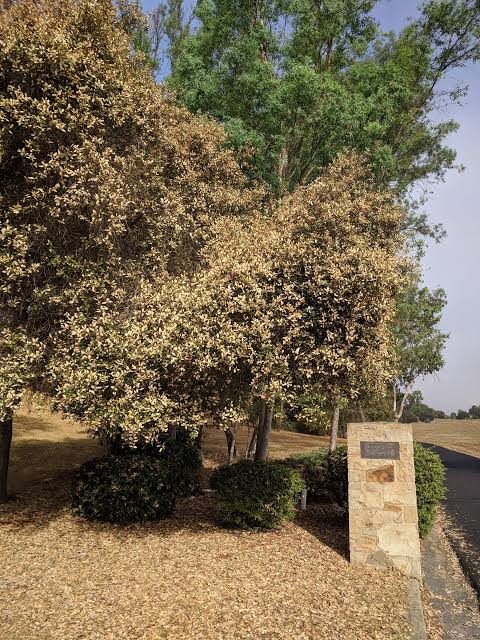 Heat & drought scorch

What's going on
The tree is rationing water
A tree cools itself and moves nutrients by pulling water up from its roots and letting it evaporate out through its leaves. In a Central Texas summer, when it is over 100 degrees and the soil has gone dry and hard, the leaves lose water faster than the roots can replace it. So the tree does what it has to: it lets the edges of leaves dry out, drops some leaves entirely, and slows down.
That is why the damage shows up as scorched margins and mid-summer leaf drop. It looks alarming, but it is mostly the tree protecting itself, shedding water-hungry leaf area it cannot afford. Our heavy clay and thin caliche soils make it worse, because they hold water tightly and dry hard at the surface. The good news is that a healthy tree given the right water usually rides it out.
What it looks like
The signs of a thirsty tree
Heat and drought stress shows up in a familiar cluster. Seeing several of these together, in a hot, dry stretch, points to water, not disease.
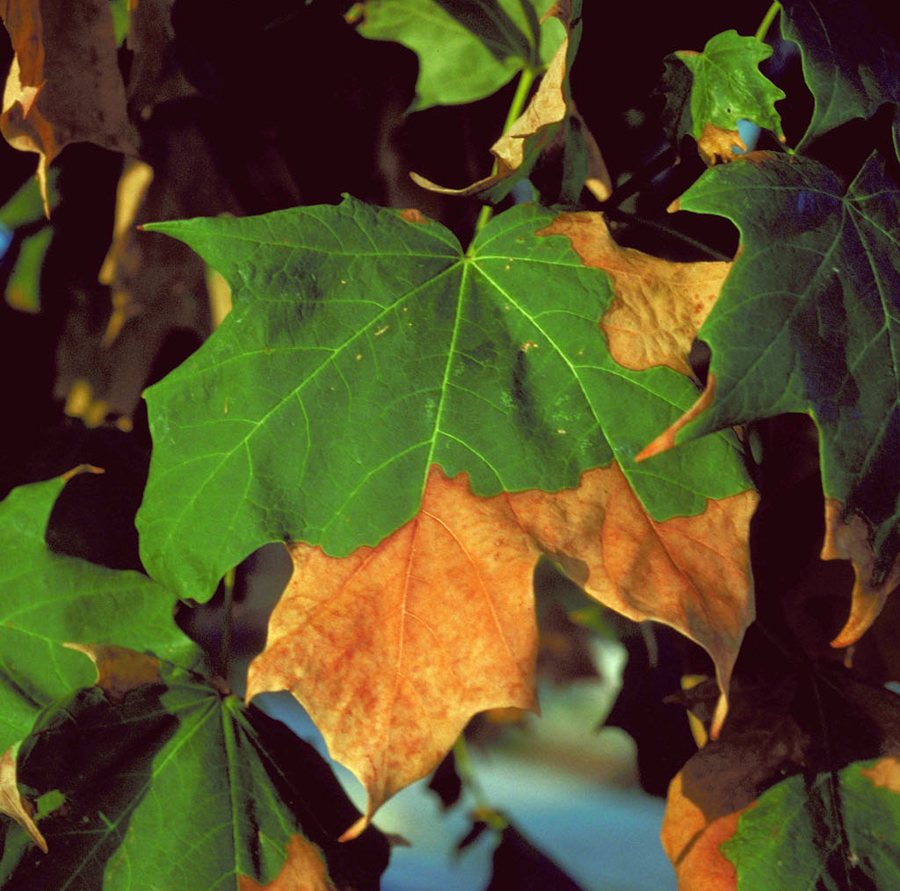
Leaf scorch
Brown, crispy edges and tips while the tissue along the veins stays greener. The margins dry first because they are farthest from the water supply.
Wilting
Leaves droop, curl, or go limp in the afternoon. If they perk back up overnight after a deep soak, that is a good sign the tree is just stressed.
Leaf drop
The tree sheds leaves in mid-summer, often from the inner canopy first, leaving litter on the ground. This is a core survival move: less leaf, less water lost.
Yellowing & early fall color
Foliage pales, yellows, or throws red and brown fall color weeks early. A drought-stressed tree can look like it is turning in August.
Thinning & tip dieback
The canopy looks sparse and you can see more sky through it, and small twigs die back at the outer and upper crown first.
Bark sunscald
When a thinning canopy stops shading the trunk, bark on the south and west sides can crack, split, or slough, a sign the heat is reaching the wood.
How worried to be
Stress response, or real decline?
Almost every tree in Central Texas shows some heat stress by late summer. The question is whether it is riding it out or sliding downhill. Here is roughly where the line sits.
The tree is coping
- Afternoon wilting that recovers overnight after a deep watering
- Moderate leaf scorch on the margins without widespread twig death
- Mid-summer leaf drop where the twigs stay flexible and buds are set for next year
- Early fall color for one season, with no progressive dieback
Red-flag signs
- Whole-canopy browning or heavy defoliation that does not recover
- Dieback from the top down, larger branches dying back, not just twig tips
- A thin canopy that does not fill back in the following spring
- Bark splitting and sloughing, or drought symptoms stacked with conks, borers, or oozing
The one thing that helps most
How to water a tree that is actually thirsty
Trees are killed as often by shallow, frequent sprinkler watering as by neglect. What a tree wants in a drought is the opposite: a slow, deep soak, spaced well apart.
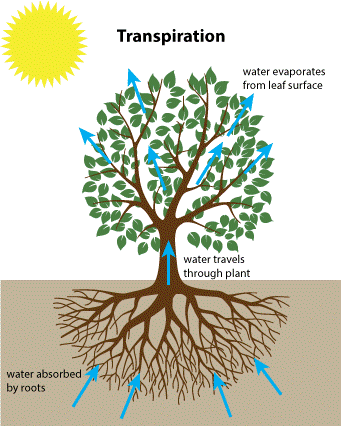
Every drop a tree spends makes this trip: up from the roots, through the trunk, and out through the leaves. A drought cuts it off at the source, which is why a slow, deep soak at the root zone is what brings the tree back.
Check the soil, not the calendar. Push a long screwdriver into the ground under the canopy. If you cannot drive it down 6 to 8 inches, the soil is dry and it is time to water. If it slides in easily, wait.
Why the urgency: soil clings to its last water. As the ground dries toward what soil scientists call the permanent wilting point, the moisture left behind is held so tightly to the soil particles that roots can no longer pull it free, and the tree wilts while the dirt still feels faintly damp. The job is to refill the soil before it gets there.
- Soak deep: water long enough to wet the soil 12 to 18 inches down, where the roots are.
- At the dripline: apply water in a wide ring at and beyond the outer canopy, not against the trunk.
- Go slow: a soaker hose or a hose at a trickle beats a sprinkler, which mostly evaporates. Keep the flow low so our clay soils absorb it instead of running off.
- Space it out: in a 100-degree stretch that is often a deep soak every 10 to 21 days, guided by the screwdriver test, not a daily schedule.
- Time it right: water in the early morning or evening to beat the evaporation.
Want a number to aim for? The Texas A&M Forest Service sizes it by the trunk: roughly 1 to 2 gallons per inch of trunk diameter in an extreme drought, applied slowly over the root zone. Use that as a baseline, then let the screwdriver test set how often.
The rest of the playbook
Help it, and don't accidentally hurt it
Water is most of the battle. The rest is mulch, and resisting the urge to do the things that feel helpful but pile more stress on a tree that is already struggling.
Do
- Mulch the root zone. Two to three inches of wood mulch out toward the dripline holds moisture and cools the soil, doing more good than any product.
- Keep mulch off the trunk. Leave a few inches of bare ground around the flare. A mulch volcano piled on the bark invites rot.
- Protect the root zone. No parking, no stacking, no digging under the canopy. Compaction and root cuts are what turn stress into decline.
- Feed the soil with compost, not fertilizer, and save it for cooler, wetter weather.
Don't
- Don't fertilize a stressed tree. Quick-release fertilizer forces thirsty new growth and the salts dry out roots. It is the opposite of what a drought-stressed tree needs.
- Don't do heavy pruning in the heat. Sealing big wounds costs energy the tree needs to survive. Save major work for fall or winter, and keep any live-leaf removal well under a quarter of the canopy.
- Don't drown it either. Constantly soggy soil suffocates roots. Deep and spaced-out beats daily.
- Don't dig holes to "water deeper." It dries the root zone and tears roots. A slow surface soak gets down there fine.
Drought opens the door for worse
Plain heat scorch is even across the tree and tracks the weather. What deserves a closer look is when the pattern does not fit, because several serious problems look like drought or ride in behind it. A stressed tree is a target.
Fast, one-sided browning that follows the veins can be oak wilt, not drought. A slow, year-after-year marginal scorch on an oak may be bacterial leaf scorch. And drought is exactly the stress that lets an opportunist like hypoxylon canker or wood-boring beetles finish off an already-weakened tree. Drought also raises the risk on live oaks by driving the kind of stress oak wilt exploits.
So if the browning is lopsided, fast-moving, or paired with dead branches, bark sloughing, or fungus, treat it as more than thirst and have it looked at on site before you assume it is only the weather.
Know your tree
Some Central Texas trees take the heat better
How hard you need to work in a drought depends a lot on what you are growing. Roughly how the common Austin-area trees stack up.
| Category | Common Central Texas examples | What it means in a drought |
|---|---|---|
| Tough once established | Escarpment live oak, cedar elm, bur oak, Mexican white oak (Monterrey oak) | Strong long-term choices for our climate. Still want a deep soak in a multi-week 100-degree drought, and for the first few years after planting. |
| Tough, but touchy about roots | Post oak | Drought-adapted to undisturbed upland soil, but very sensitive to root disturbance. Construction, grade changes, and even new irrigation near a post oak often trigger decline. Leave the root zone alone. |
| Higher risk under stress | Red oaks (Texas red oak, Shumard), some non-native shade trees | Can do well, but more vulnerable to decline and to oak wilt when drought-stressed. Watch these closely for scorch and dieback and respond early. |
| Thirsty by nature | River birch, Japanese maple, dogwood, magnolia and other moisture-loving species | Adapted to wetter ground than we have. Expect them to struggle in an Austin summer without regular supplemental water. |
Drought-tolerant does not mean no water. Even a live oak benefits from a targeted deep soak during a long, brutal drought, and keeping it out of chronic stress is one of the best things you can do to protect it from oak wilt.
Not sure if it's just the heat, or something worse?
Send me a photo of the leaves and the whole tree and I will tell you whether you are looking at ordinary heat stress that a good watering will carry, or a pattern that needs a real diagnosis, before you spend money guessing.
This page is educational and does not diagnose any specific tree. Heat and drought symptoms overlap with several diseases and disorders, so when the pattern is unclear, one-sided, or a tree is genuinely declining, have it evaluated on site before treating. Watering amounts and timing should be adapted to your soil, your tree, and any local watering restrictions in effect. Guidance here draws on Texas A&M Forest Service and AgriLife Extension recommendations.