
Storm Damage • Central Texas
Your tree was struck by lightning
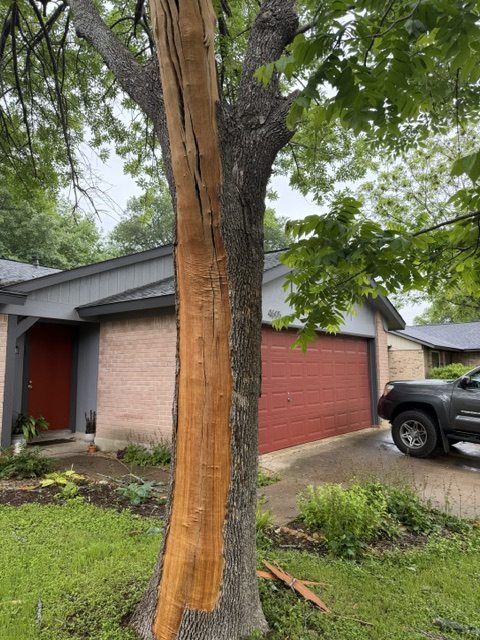
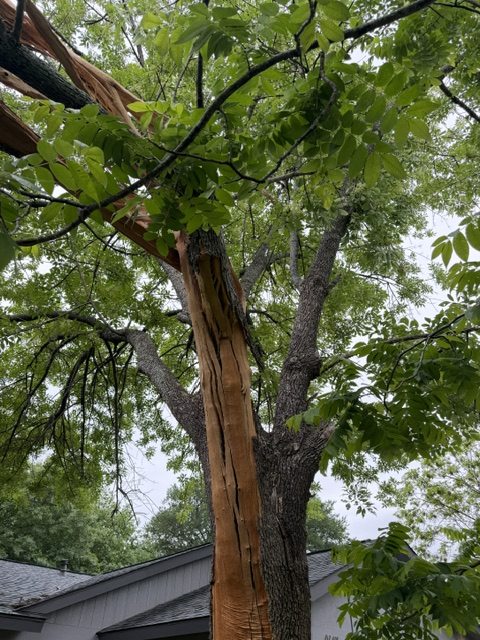
A long strip of bark blown clean off the trunk, fresh wood exposed top to bottom: that is the signature of a lightning strike, not ordinary storm wind. Some of these trees pull through. Some are now a hazard over your roof. Here is how to tell the difference and what to do first.

What actually happened
Why the bark blew off
When lightning hits a tree, it follows the path of least resistance, usually the moist layer just under the bark. The current flashes the sap there to steam almost instantly, and the pressure blows the bark and outer wood off in a strip running down the trunk toward the ground.
That exposed channel is the wound. Whether the tree lives comes down to how much of the cambium, the thin living layer that moves water and food, was destroyed around the circumference. A narrow strip can heal over. A strike that girdles most of the trunk usually does not.
Tell them apart
Lightning or storm wind
They both show up after the same Texas thunderstorm, but the damage looks different and points to different risks.
A channel down the trunk
- A continuous, roughly vertical strip of bark blown off the stem
- Fresh exposed sapwood running toward the ground
- Sometimes a matching exit wound at the base or over the roots
- Splintered, blown-apart wood rather than a clean break
Broken and torn limbs
- Snapped branches and failed branch unions
- Tearing at the attachment, not a strip down the trunk
- Whole-tree lean or uprooting in saturated soil
- Hangers and widow-makers caught in the canopy
From the field
One strike, top to bottom
The same Central Texas Arizona ash (Fraxinus velutina), photographed after a strike. The current ran from the canopy to the ground.


Treat it as a hazard until it is checked
Keep people and cars out from under the tree. Assume any limb hung up in the canopy can still come down, and never touch a tree that is contacting a power line, call the utility. A fresh strike can leave cracks you cannot see from the ground, so the safest move is to keep the area clear until it has had a documented tree risk assessment by a qualified arborist.
Can it be saved
Save it, or take it down
There is no single answer from a photo. It comes down to how much living tissue is left, the structure that remains, and what sits under the tree. These are the signals I weigh on site.
Leans toward saving
- A narrow strip of damage, most of the trunk's cambium still intact
- No major structural crack running deep into the stem
- A sound, high-value tree that was healthy before the strike
- Nothing valuable directly under the canopy if a limb did fail
Leans toward removal
- Damage wrapping most of the trunk, effectively girdling it
- Deep cracks, or broken limbs hanging over a roof or driveway
- A weak-wooded, short-lived species like Arizona ash already in decline
- A target below, a house, cars, a walkway, that raises the stakes
Lightning hit one of your trees? Let's look before you cut
Send me photos of the trunk and the canopy and I will tell you whether you are likely looking at a tree that can be saved or one that needs to come down, and how urgent it is.
This page is educational and does not assess any specific tree. A lightning or storm damaged tree should be evaluated in person, and any tree contacting a power line is an emergency for the utility, not a do-it-yourself job. When a damaged tree threatens people or property, have it assessed on site before deciding to save or remove it.