
Invasive Pests • Central Texas
The Emerald Ash Borer Is Almost Here
A metallic-green beetle no longer than a grain of rice has already killed hundreds of millions of ash trees across North America. It is now confirmed within a couple hours of Austin, and it kills essentially every untreated ash it reaches. If you own a healthy ash, the time to plan is before it arrives, not after.

What's going on
A jewel beetle that kills from the inside
The emerald ash borer is a small, bullet-shaped beetle native to northeastern Asia, first found in North America near Detroit in 2002. Since then it has spread across dozens of states and killed hundreds of millions of ash trees, with billions more at risk. It is widely considered the most destructive forest insect ever to reach the continent.
The adult beetle is not the problem. The damage is done by its larvae, which hatch under the bark and tunnel through the living tissue that moves water and food up and down the trunk. A few seasons of that tunnelling girdles the tree from within, and because our native ash never evolved alongside this insect, they have no defense. An untreated infested ash typically dies within two to four years.
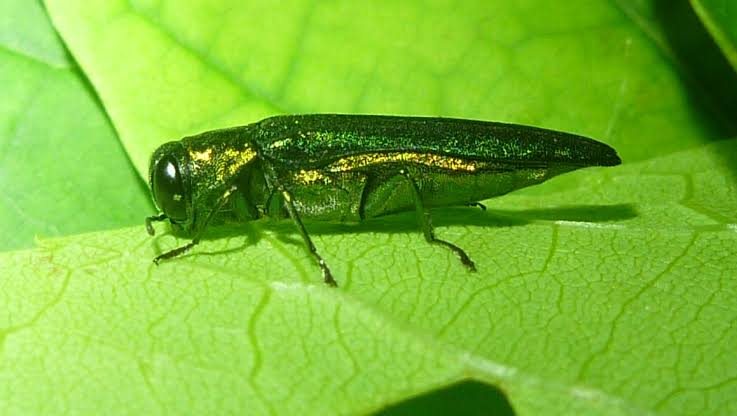
Agrilus planipennis, family Buprestidae, the metallic wood-boring or jewel beetles. Adults are about half an inch long.
What it looks like
From one beetle to a dead woodlot
The same story at three scales: the beetle that does it, a single ash dying from the top down, and what a stand of ash looks like a few years after it moves through.


Where it stands right now
Close enough that the clock has started
The honest read for Central Texas as of mid-2026: not confirmed in Travis County yet, but close enough, and moving fast enough, that waiting is the risky choice.
- First found in Texas in 2016 in Harrison County, near the Louisiana line. It has since been confirmed in 36 counties and keeps pushing west and south.
- The nearest confirmations to us are in Bell, McLennan, Hill, and Bosque counties, the Waco and Temple area, roughly one to two hours from Austin.
- Travis, Williamson, and Hays are not on the state's confirmed list yet. But the City of Austin has already started removing ash and asking residents to inspect their trees.
- The rule of thumb from other states: start protecting high-value ash once the borer is confirmed within about 15 to 30 miles. For parts of the metro, that line has effectively been crossed.
How to know it's the borer
Read the trunk and the crown together
No single sign is proof on its own, and early damage looks a lot like drought. It is the stack of signs, on an ash, that tells the story.
Emerald ash borer
- Top-down dieback, the upper crown thinning and dying first, worse each year
- Trunk and basal sprouts, leafy shoots erupting low as the tree tries to compensate
- Vertical bark splits over the tunnels, and woodpecker blonding, pale patches where birds flake off bark chasing larvae
- D-shaped exit holes about an eighth of an inch, and S-shaped, frass-packed galleries just under the bark
What it isn't
- It has to be an ash. The borer only kills ash, plus the occasional white fringetree. It does not touch oaks, elms, or Chinese pistache
- Round exit holes mean a different, far less serious borer. The borer's hole is a flattened D
- Drought and root stress thin a crown too, but evenly, not from the top down with tunnels underneath
- When the signs don't add up, or a valued ash is declining, that is the moment for an on-site look rather than a guess
The year
One generation, hidden almost all of it
The borer runs a single generation a year in Texas, and spends most of that year out of sight under the bark. That is exactly why it is so far along by the time a tree looks sick.
Field note: because the tree hides an entire year of tunnelling before the crown shows it, the trees worth protecting are the ones that still look healthy. Waiting for obvious symptoms means waiting until treatment is a much longer shot.
The options
Treat it, or plan its replacement
For an ash in the borer's path there are really three paths. Which one fits depends on the tree's health, size, and value to you.
Trunk injection
Emamectin benzoate, injected into the trunk by a licensed applicator, is the most durable protection, good for roughly two to three years per treatment. It stays inside the tree, so off-target exposure is low. This is the tool for a large, healthy, meaningful ash.
Soil or basal drench
Imidacloprid or dinotefuran applied to the soil or lower bark is taken up by the roots. It costs less per application but generally needs redoing every year, works best on smaller trunks, and carries more pollinator caution as a neonicotinoid.
Remove and replace
Once an ash has lost more than about a quarter to half its canopy, treatment rarely pays. A dead ash near a house or drive turns brittle fast, so the sound move is planned removal before it becomes a hazard, guided by a documented risk assessment, and replanting with resilient, non-ash natives.
What to do
Move early, on the right trees
You cannot spray your way out of this reactively. The wins come from knowing which trees you have and acting before the borer is on them.
Do
- Find out if you even have ash. Much of Austin's older tree stock is Arizona ash. If it's not an ash, you can stop worrying about this one.
- Protect healthy, high-value ash now. With confirmed infestations inside the treat-now radius, a preventive injection is a defensible call for a tree worth keeping.
- Get a real diagnosis early, while the crown still looks good and treatment odds are best.
- Diversify new plantings. When you replant, choose resilient natives over another ash.
Never
- Move ash firewood. This is how the borer makes its long jumps. Buy and burn wood where you use it.
- Wait for exit holes. By the time you see D-shaped holes, the tree has usually been infested for a year or more.
- Plant a new green ash anywhere the borer is spreading. You are planting a future removal.
- Pour money into a tree that's already half dead. Past the canopy threshold, removal is the honest answer.
A healthy ash can be carried through this
The borer is grim news for wild ash, but for a specific, cared-for tree in your yard the story is better. A healthy ash, treated in time, can be protected right through the wave of infestation and kept alive while untreated trees around it die. People are keeping beloved ash trees standing this way across the country.
The whole game is timing. Treatment protects a tree that still has most of its canopy. Once decline is well underway, past roughly a quarter to half the crown, the same money is better spent on safe removal and a good replacement. Knowing which side of that line your tree is on is exactly what an on-site look settles.
Don't move firewood, and report what you see
The federal quarantine on ash was lifted in 2020, so the front line now is simple behavior. The borer can't fly far on its own; it hitchhikes in firewood and ash wood. Buy firewood where you'll burn it, and never haul ash wood to the lake, the deer lease, or the campsite.
If you spot the signs, S-shaped galleries under loose bark, D-shaped exit holes, or an ash dying from the top down, leave the wood where it is and report it to the Texas A&M Forest Service EAB hotline at 1-866-322-4512. Early reports are how a neighborhood buys itself time.
Not sure if you have ash, or if it's worth protecting? Let's find out
Send me a photo of the tree, the leaves, and any bark damage, and I'll tell you whether it's even an ash, whether the emerald ash borer is a real risk for it, and whether preventive treatment makes sense before you spend a dollar. If it's already too far gone, I'll tell you that too.
This page is educational and does not diagnose any specific tree. Emerald ash borer confirmation is made by trained officials, and suspected finds should be reported to the Texas A&M Forest Service. County status and spread change over time, so verify current conditions for your area. Pesticide choices, rates, and timing should follow the product label and local conditions, and pollinator protection should always be considered on flowering plants.