
Landscape & Garden Pests • Central Texas
The Ant That Farms a Fungus
When you find a moving green ribbon crossing your yard, each ant holding a scrap of leaf overhead like a tiny sail, you have met the Texas leaf-cutting ant. Here is the twist that decides everything about controlling it: the ants are not eating your plants. They are harvesting them to grow an underground fungus, and the fungus is what they eat.
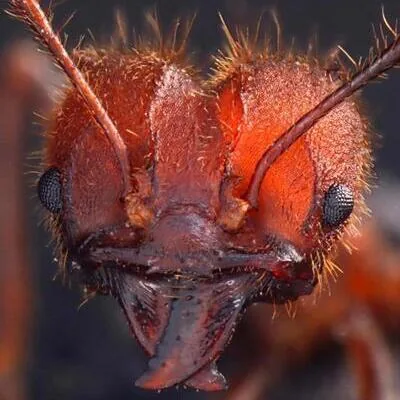 Texas leaf-cutting ant • Atta texana

What's going on
They cut your leaves to grow a garden
Leaf-cutting ants are among the few animals besides us that farm their own food. Foragers snip crescents out of leaves, flowers, and tender shoots with scissor-like jaws, then relay the pieces underground in long marching columns. Down in the nest, smaller workers chew that plant material into a mulch and grow a specialized fungus on it. The colony, from the queen to the youngest larva, eats only that fungus.
That single fact is the whole story. The plant damage you see is not feeding, it is harvesting compost. And because the ants never actually eat the leaves, the sweet and greasy baits that stop fire ants and kitchen ants do nothing here. You are not fighting an insect that eats, you are fighting a farm.
Atta texana. Also called the town ant, parasol ant, or cut ant. The northernmost member of the leaf-cutter genus Atta, which is among the most destructive plant pests in the tropical Americas.
How to know it's them
Three signs, and they're unmistakable
Nothing else in a Central Texas yard behaves like this. Once you have seen the parade, you never confuse it with fire ants again.
Green sails on the march
A steady, well-worn trail of ants, each carrying a bright fragment of leaf held up over its back like a parasol. The columns run in both directions, loaded ants heading home, empty ants heading out, sometimes for hundreds of feet.
Scalloped, overnight
Neat half-moon bites taken out of leaf edges, and whole plants defoliated fast. They prefer young, tender growth, so a rose, a garden bed, or a newly planted tree can go from full to bare in a single night.
A sandy crater field
Not one neat cone but a broad patch of loose, sandy, disturbed soil pocked with dozens of small entrance holes, always on well-drained deep sand. This central "town ant" nest is the colony's heart, and it sits far deeper than it looks.
One colony, one queen
A city of sisters in many sizes
A single leaf-cutting ant colony is one giant family, all daughters of one queen, built in a range of body sizes for different jobs.

The little ones you rarely see. Tiny gardeners stay below ground tending the fungus, while the large-jawed cutters and soldiers are the ones out on the trail doing the visible damage. This division of labor is why the colony is so efficient, and so hard to stop by picking off the ants you can see.
In spring, a mature colony releases winged males and queens for a nuptial flight. They mate in the air, the males die, and each newly mated queen digs in on a patch of sandy ground, carrying a starter pellet of fungus in her mouth to seed the next farm. That is how a new nest, and next year's problem, begins.
Follow the sand
The nest goes deeper than you think
Leaf-cutting ants are tied to one kind of ground. Find that, and the trails, and you can find the central nest, which is the only thing worth treating.
- Confined to well-drained, deep sandy soils, on rises and upland spots
- A central nest that can reach 25 feet deep below the surface
- Up to two million ants in a mature colony
- Dozens of scattered entrance holes, plus smaller satellite mounds nearby
- A honeycomb of underground chambers holding the fungus gardens
- Foraging trails running hundreds of feet out to host plants
Because the colony lives so far down, the small mounds at the surface are just the chimneys of a buried city. Treating the outer satellite mounds, or the trail, or the plant being stripped, leaves the queen and the fungus untouched, and the colony simply rebuilds.
Timing matters when you inspect. In the summer heat they forage mostly at night, starting near dusk, and stay underground during the day. In cooler weather, late fall through early spring, they switch to foraging in the daytime. So if the trail looks dead at noon in July, come back at dusk.
Field rule: treat the nest, not the trail. Everything else is temporary.
In East Texas, this is a forestry-scale pest
Figures from Texas A&M Forest Service. The same colonies that defoliate pine seedlings by the acre are the ones stripping roses and fruit trees in a South and Central Texas yard, which is why they are worth taking seriously.
Why your fire ant bait does nothing
Ordinary ant baits work by being eaten: the ant takes the poisoned food, shares it, and the colony dies. Leaf-cutting ants break that entirely, because they do not eat bait. They eat fungus. Set out fire ant bait or a household ant trap and the foragers will walk right past it.
The bait that does work is one specifically labeled for leaf-cutting ants, hydramethylnon, sold as Amdro Ant Block. It succeeds by a trick: the workers treat the granules like any other harvest, carry them down, and work them into the fungus gardens. From there the active ingredient reaches the fungus the whole colony depends on. Match the farm, and the bait finally gets carried home.
What actually works
Treat the nest, protect the plant
Control comes down to hitting the central colony with the right bait, and buying your high-value plants some cover while you do. Several of the obvious moves are wasted effort.
Do
- Treat the central nest, not the trail or the plant. It is the only target that ends the colony.
- Use a bait labeled for leaf-cutting ants (hydramethylnon / Amdro Ant Block), spread around the active nest while ants are foraging.
- Plan to repeat. A single application clears only about a third of colonies, so big, old nests take several rounds.
- Shield a few key plants short-term with a labeled contact insecticide on roses or a young tree while you work the nest.
- Inspect at dusk in summer, when they are active, and follow the trails back to the central mound.
Won't work
- Fire ant and household ant baits. They farm fungus, so they never take the bait.
- Spraying the trail or the ants you see. The colony underground is untouched and refills the line by morning.
- Treating only the satellite mounds. Miss the central nest and it rebuilds from the queen.
- Expecting one treatment to finish it. A mature colony almost always needs follow-up.
- Flooding or burning the mound. A nest 25 feet deep shrugs it off, and it is unsafe besides.
The tree side is my lane, the big nest may need a pro
Where I come in is the plants. If leaf-cutting ants are stripping a newly planted or young tree, or working over high-value ornamentals, the real question is how much defoliation that plant can take and how to protect it through the season. A young or recently transplanted tree that gets stripped repeatedly is at genuine risk, and that is a plant-health call I can make with you.
For the colony itself, a small nest often responds to the labeled bait used patiently. But a large, established nest usually needs professional nest injection with a restricted product, applied into every entrance hole, which is work for a licensed applicator. I will tell you honestly which situation you are in, and point you to the right treatment rather than sell you a spray that cannot reach the queen.
Ants marching off with your leaves? Let's protect the tree
Send me a photo of the trail, the damage, and the mound, and I will confirm whether it is the Texas leaf-cutting ant, tell you whether your young trees and plants are at real risk, and steer you to the treatment that actually reaches the nest.
This page is educational and does not diagnose any specific tree or infestation. Any pesticide use should follow the product label and local regulations, and some effective products are restricted to licensed applicators. Insect facts and impact figures here draw on Texas A&M Forest Service and Texas A&M AgriLife Extension guidance on the Texas leaf-cutting ant (Atta texana).