
Tree Pests • Central Texas
The Speckled Leaf and the Lace Bug
When an oak's leaves go pale and sandblasted-looking by midsummer, homeowners tend to fear the worst. Usually the culprit is a tiny insect feeding on the underside of the leaf, the lace bug, and the good news is that on a healthy tree the damage is mostly skin deep.

What's going on
A tiny bug with lacy wings
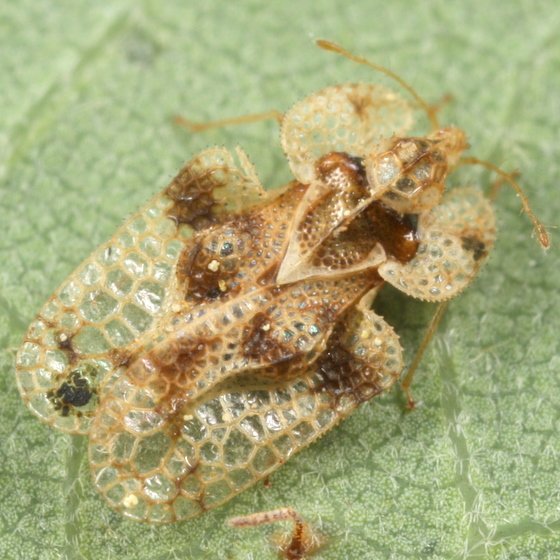
Lace bugs are small sap-sucking insects, only a few millimeters long, named for the clear, sculptured, lace-like pattern of their wings and hood. They live and feed on the underside of the leaf, where you rarely look, which is why the damage usually gets noticed long before the bug does.
As they feed they pull the green out of the leaf in tiny dots. From above this reads as fine pale stippling that spreads into a yellow or bronze cast as the season goes on. In Central Texas they show up most on oaks, white oaks especially, and on a range of other deciduous shade trees.
Family Tingidae, mostly Corythucha species. Oak lace bug on oaks, sycamore lace bug (Corythucha ciliata) on sycamore.
What it looks like
From the underside to the whole canopy
The same feeding story at three scales, from the specks on a single leaf out to a hazy summer canopy.


How to know it's lace bugs
The tell is on the back of the leaf
From above, lace bug stippling looks a lot like spider mites or the early edge of leaf scorch. What settles it is turning the leaf over.
Lace bugs
- Shiny black fecal spots like drops of varnish, scattered on the underside
- Shed skins stuck to the leaf, the cast-off armor of growing nymphs
- Egg clusters of dark spikes, standing like a miniature Stonehenge, 30 to 50 in a patch under three quarters of an inch
- The lacy adults themselves, sitting still until disturbed
The look-alikes
- Spider mites stipple the same way but leave fine webbing and no black fecal spots
- Leaf scorch and drought brown from the leaf edges inward, not in even speckles across the blade
- Oak wilt is a different animal: it follows the veins and moves fast through a tree, and it has no bugs or droppings underneath
- When the pattern does not add up, that is the time to have it looked at rather than guessed at
The season
Why the damage builds all summer
Lace bugs stack up generation on generation through the warm months, so a light spring stippling can become a bronzed canopy by August. Here is the arc of a Central Texas year.
Field note: because the young, soft nymphs are the vulnerable stage, the only time treatment does much good is early, while they are active on the leaves. Spraying bronzed leaves in September mostly just spends money.
On a healthy tree, this is mostly cosmetic
It looks alarming, but lace bug feeding is mostly aesthetic damage. A big, established, well-watered oak carries a season of stippled leaves without any lasting harm, keeps the canopy through summer, and pushes a clean flush of new leaves the following spring. The color does not return to the damaged leaves, but the tree is not in danger.
Lace bugs become a genuine concern only when the pressure is heavy and repeated year after year, or when the tree is already stressed by drought, construction, or root problems, or is young and small enough that losing leaf function actually costs it. That is the difference between a nuisance and a problem worth spending on, and it is exactly the call an on-site look is for.
What to do
Least aggressive tool that works
Most lace bug situations on shade trees need no spraying at all. When they do, the goal is to hit the vulnerable stage without wiping out the insects that keep them in check.
Do
- Keep the tree vigorous with deep, correct watering and mulch. A healthy tree shrugs off lace bugs, which makes vigor the real treatment.
- Check the leaf undersides early in the season so you catch the young nymphs, the only stage worth spraying.
- Reach for horticultural oil or insecticidal soap if treatment is warranted, coating the undersides thoroughly, since these work only on contact.
- Protect the good bugs. Lady beetles, lacewings, assassin bugs, and pirate bugs eat lace bugs for free.
Never
- Reflexively spray a big, healthy oak for cosmetic stippling. It is rarely worth the cost or the collateral on beneficial insects.
- Spray oils or soaps in 90°F-plus heat. It scorches the leaves. Treat in the cool of the morning.
- Expect stippled leaves to green back up. The damaged tissue stays marked. New growth is your fresh start.
- Reach for a systemic first. See the pollinator note below before anything moves into the tree's sap.
Systemics are a last resort, not a first move
For a severe, chronic infestation, or a tree too tall to spray the undersides, a licensed applicator may use a systemic insecticide such as dinotefuran, imidacloprid, or acephate, which the tree carries into every feeding insect. Used correctly, on the right tree, they work.
But they are the last tool, not the first. Many oaks flower and are visited by bees and other pollinators, and systemic neonicotinoids can move into nectar and pollen and linger there. So a systemic on a landscape tree is a careful, label-driven decision that weighs bloom timing and pollinator exposure, not a reflex for a leaf that simply looks speckled.
Speckled, bronzing leaves and not sure what it is? Let's look
Send me a photo of the leaves, top and underside, and I will tell you whether you are looking at harmless lace bugs, something that needs treating, or a different problem entirely, before you spend a dollar on spray.
This page is educational and does not diagnose any specific tree. Look-alike symptoms can point to very different causes, so when the pattern is unclear, or a tree is declining, have it evaluated on site before treating. Pesticide choices, rates, and timing should follow the product label and local conditions, and pollinator protection should always be considered on flowering plants.