
Crepe Myrtle Care • Central Texas
Sticky Leaves and Black Bark
When a crepe myrtle goes sticky and the bark turns sooty black, two different pests are usually behind it: aphids on the leaves and bark scale on the wood. Both feed the same black mold. Here is how to tell them apart and shut them down without poisoning the bees.

What's going on
Two bugs, one sticky mess
That shine on the leaves and the patio furniture is honeydew, the sugary waste that sap-sucking insects leave behind. On crepe myrtles it comes from one of two pests, and often both: crepe myrtle aphids feeding on the leaves, and crapemyrtle bark scale encrusting the trunk and branches.
Wherever the honeydew lands, a black fungus called sooty mold grows on it. The mold is the part everyone notices, but it is only a symptom. It does not infect the tree, it just feeds on the sugar. Stop the insect, the honeydew stops, and the mold weathers off on its own.
Tinocallis kahawaluokalani (aphid) • Acanthococcus lagerstroemiae (bark scale)
What it looks like
Sooty mold in the field
The same honeydew story, from the first flecks to a shrub filmed solid black. All Central Texas field photos.


Tell them apart
Aphids or bark scale
They cause the same sticky, sooty result, but they look nothing alike and they are not handled the same way. Check the leaves and check the bark.

Crepe myrtle aphids
Tinocallis kahawaluokalani
- Soft, pale green to yellow insects, smaller than a pinhead
- Cluster on the undersides of the leaves where they feed
- Worst in the warm months, and they explode fast in heat
- Leaves get sticky, then black, and may yellow and drop

Crapemyrtle bark scale
Acanthococcus lagerstroemiae
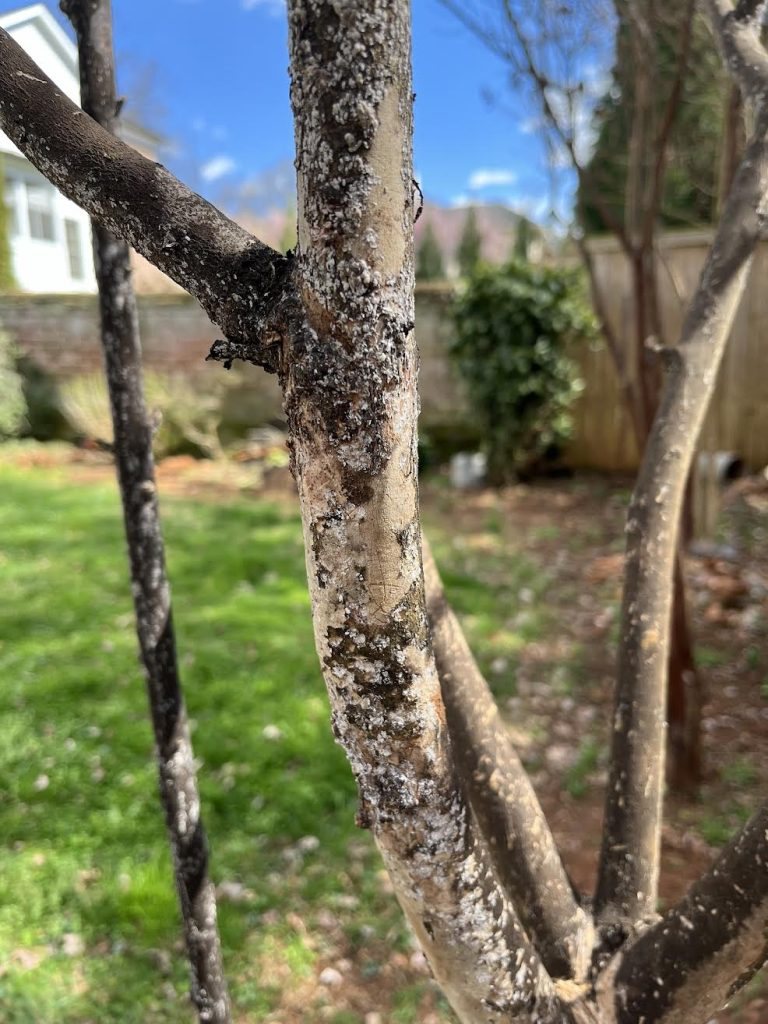
- White to gray felt-like crust on the trunk, branches, and crotches
- Bleeds pink when you crush it, a quick confirming test
- Stays on the wood year round, not just in summer
- Often the cause when the whole trunk goes sooty black, like the photo above
Not every bug is a pest
Bark lice: the look-alike to leave alone
Before you spray anything on the bark, look closer. If the crust is actually a herd of little gray insects moving across the trunk, that is bark lice, and they are on your side, not the tree's enemy.


Watch it, then poke it
Bark scale is a white, waxy crust that stays put and bleeds pink when you press it. Bark lice are separate gray insects that move as a herd and do not bleed pink. If the patch scatters when you touch it, it is bark lice, and the right treatment is none. They graze the same sooty mold the scale creates, so left alone they are a beneficial cleanup crew.
Why it spreads
Honeydew, mold, and ants
The three feed each other. Understand the loop and you know where to break it.
Sugar coats everything
Aphids and scale drink more sap than they can use and excrete the excess as a sticky film, onto lower leaves, the bark, and whatever sits beneath the tree, cars and patios included.
Black film on the sugar
Sooty mold is a harmless-but-ugly fungus that grows on honeydew. A heavy coat blocks light from the leaves, but it does not infect the tree. Clear the pest and it fades.
Ants farm the pests
Ants love honeydew, so they protect aphids and scale and drive off the ladybugs and lacewings that would eat them. Control the ants and you let the good bugs do free work.
What to do
Break the loop, gently first
Start with the least aggressive tool that works. Most crepe myrtle infestations come down without reaching for a systemic at all.
Do
- Blast the foliage with a strong hose stream, hitting the leaf undersides, to knock aphids off without chemicals.
- Use insecticidal soap, neem, or horticultural oil when water is not enough, coating both sides of the leaves.
- Treat bark scale with horticultural oil on the trunk and branches, ideally in the dormant season, to smother the crust.
- Control the ants so ladybugs and lacewings can hold the pests down for you.
Never
- Spray oils or soaps in 90°F-plus heat. It burns the leaves. Treat in the cool of the morning.
- Soil-drench a blooming tree with a systemic. See the pollinator note below, this one matters.
- Expect the black to vanish overnight. Sooty mold weathers off over weeks once the honeydew stops.
- Ignore the ants. Leave them and they will undo the rest of your work.
Imidacloprid and the bees
A systemic insecticide such as imidacloprid, applied as a soil drench, is effective for stubborn aphids and scale because the plant carries it to every feeding insect. But crepe myrtles are magnets for bees when they bloom, and systemic neonicotinoids move into the nectar and pollen those bees collect.
So the rule on a flowering crepe myrtle is cautious: do not drench a tree that is blooming or about to bloom, and reach for the non-systemic options first. Neonicotinoids can linger in a plant's nectar and pollen for months, sometimes into later seasons, so timing alone does not make them safe on a tree that bees visit. If a systemic is ever truly warranted, treat it as a careful, label-driven decision, ideally one for a licensed applicator.
When to hit it
A Central Texas bark scale calendar
Bark scale is beaten on timing, not brute force. The young crawlers are the soft, exposed stage, so the whole game is hitting them while they are out. These windows follow Texas A&M AgriLife monitoring, not a textbook from another climate.
Field tip: wrap a strip of double-sided sticky tape around an infested branch and check it. When the tiny crawlers start showing up stuck to the tape, the spray window is open. It beats guessing by the calendar alone.
Crepe myrtle dripping sap and going black? Let's sort it
Send me a photo of the leaves and the trunk and I will tell you whether you are dealing with aphids, bark scale, or both, and the safest way to clear it for your tree and the bees.
This page is educational and does not diagnose any tree. Pesticide choices, rates, and timing should follow the product label and local conditions, and pollinator protection should always be considered on flowering plants. When in doubt, have the tree evaluated on site before treating.