
Plant Health Care • Central Texas
Yellow leaves, green veins
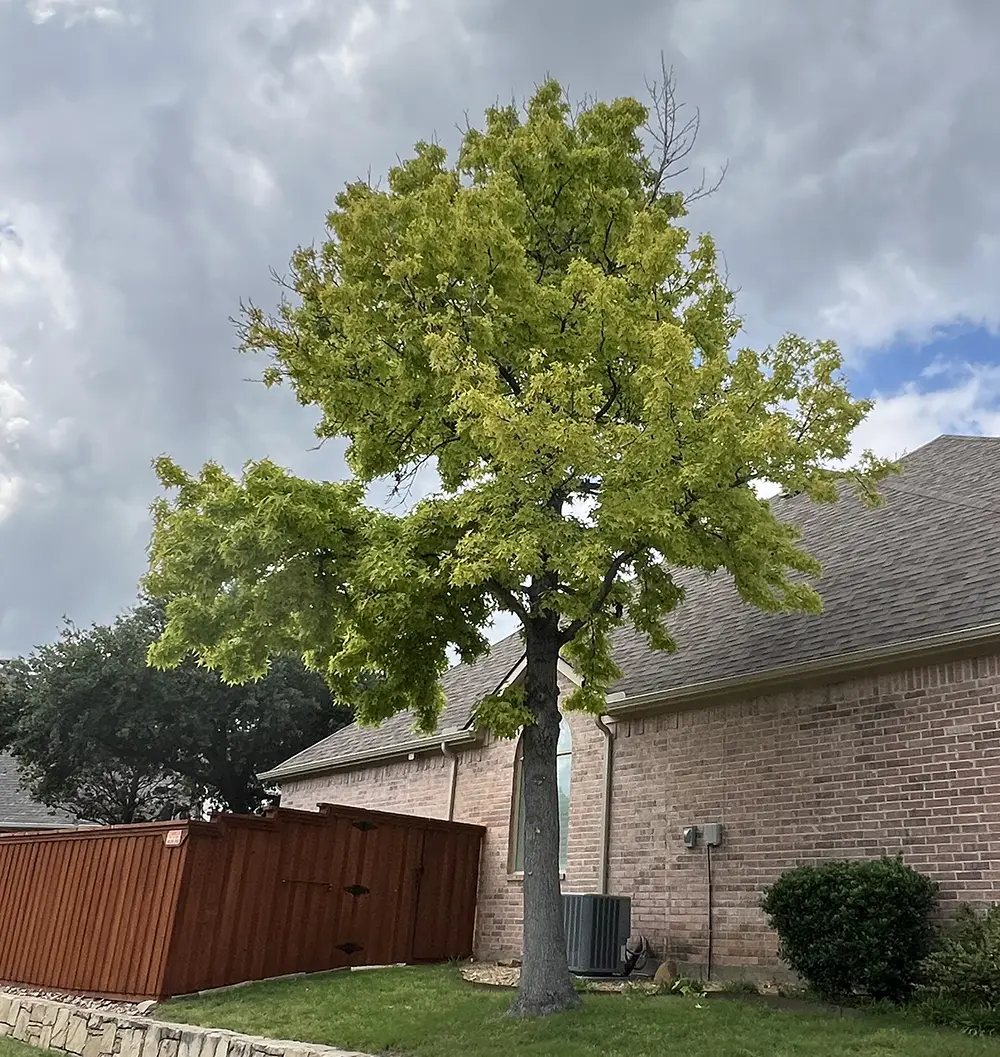
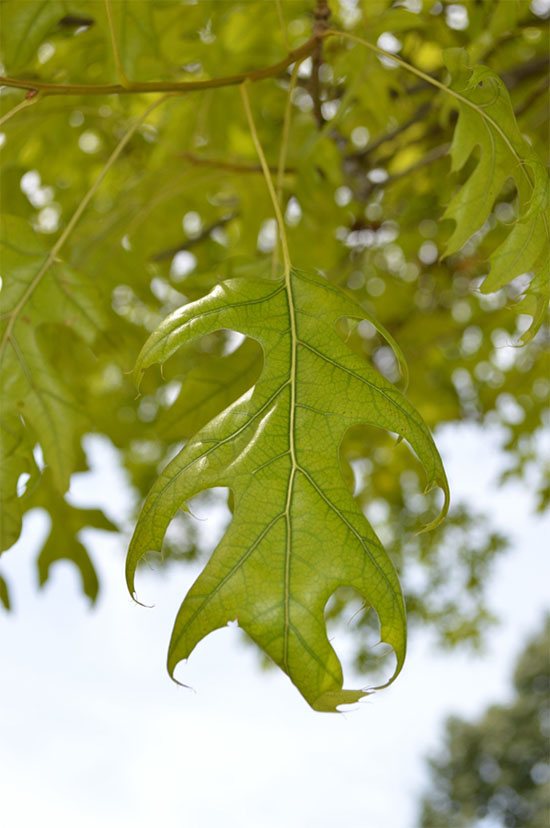
When a tree's leaves fade to yellow but the veins stay green, that is chlorosis. In Central Texas it usually is not a bug or a disease, it is the soil: high pH locking up the iron and manganese the leaves need. The good news is that, caught in time, it is one of the most fixable problems out there.

What you are seeing
Read the veins, not just the color
The pattern is the diagnosis. In chlorosis the veins stay green while the tissue between them turns yellow. That is called interveinal chlorosis, and it means the leaf cannot get enough of a micronutrient, usually iron or manganese, to build chlorophyll.
Here is the part that surprises people: the nutrient is usually already in the soil. It is just chemically locked up and unavailable. So the tree starves in the middle of plenty, and a bag of ordinary fertilizer does almost nothing.
Which nutrient
Iron or manganese
Both make the same green-vein, yellow-tissue pattern. Which one, and which tree, points to the right fix.
Iron chlorosis
- Hits the newest growth at the branch tips first
- Common on red oak, pin oak, sweetgum, and other acid-loving species
- Severe cases bleach to near white, then leaf edges scorch and die back
- Classic on trees planted in our alkaline, caliche-heavy soils
Manganese chlorosis
- Same interveinal yellowing, often a bit more banded along the veins
- Common on maples and a few other species in high-pH soil
- Frequently overlaps with iron, both locked by the same alkaline conditions
- Confirmed properly with a soil test, not by eye alone

Why it is so common here
Blame the soil, not the tree
Much of Central Texas sits on alkaline, caliche-rich soil with a pH well above neutral. At that pH, iron and manganese bind into forms roots cannot absorb, no matter how much is present.
That is why the trees that struggle most are the ones that evolved for acidic soils and got planted here anyway, red oaks, pin oaks, sweetgums, some maples. They are doing fine on water and sunlight, but they are quietly starved for a nutrient sitting right under them. Fix the availability, or pick species suited to the soil, and the problem goes away.
How to fix it
Make the nutrient available
The goal is not to dump more iron in, it is to get iron the tree can actually use, and to nudge the soil over time.
What works
- Chelated iron made for high pH (an EDDHA chelate) applied to the soil, so it stays available
- Trunk injection for a faster green-up on a high-value tree
- Lowering soil pH over time with elemental sulfur and organic matter
- Right tree, right place, choosing alkaline-tolerant species on the worst sites
What does not
- Ordinary nitrogen fertilizer. The nutrient is locked, not missing
- A non-chelated iron product that just locks up again at high pH
- Expecting overnight color. Green-up takes weeks, and soil fixes take seasons
- Ignoring it. Years of chlorosis lead to dieback that is far harder to reverse
Tree going yellow? Let's find out why
Send me a photo of the leaves and I can usually tell chlorosis from the other reasons a tree yellows, then point you to the treatment that actually fits your soil and your tree.
This page is educational and does not diagnose any specific tree. Yellowing has several possible causes, and treatment rates and methods should follow a soil test, the product label, and the specific tree and site. When a valuable tree is declining, have it evaluated on site before treating.