
Wood-Destroying Insects • Central Texas
Ant or Termite? The Carpenter Ant Question
When winged insects pour out of a windowsill or a tree cavity, the first job is telling a carpenter ant from a termite, because the fix for one does nothing for the other. And the ant, it turns out, is usually just the messenger: it moves into wood that is already wet or rotting.
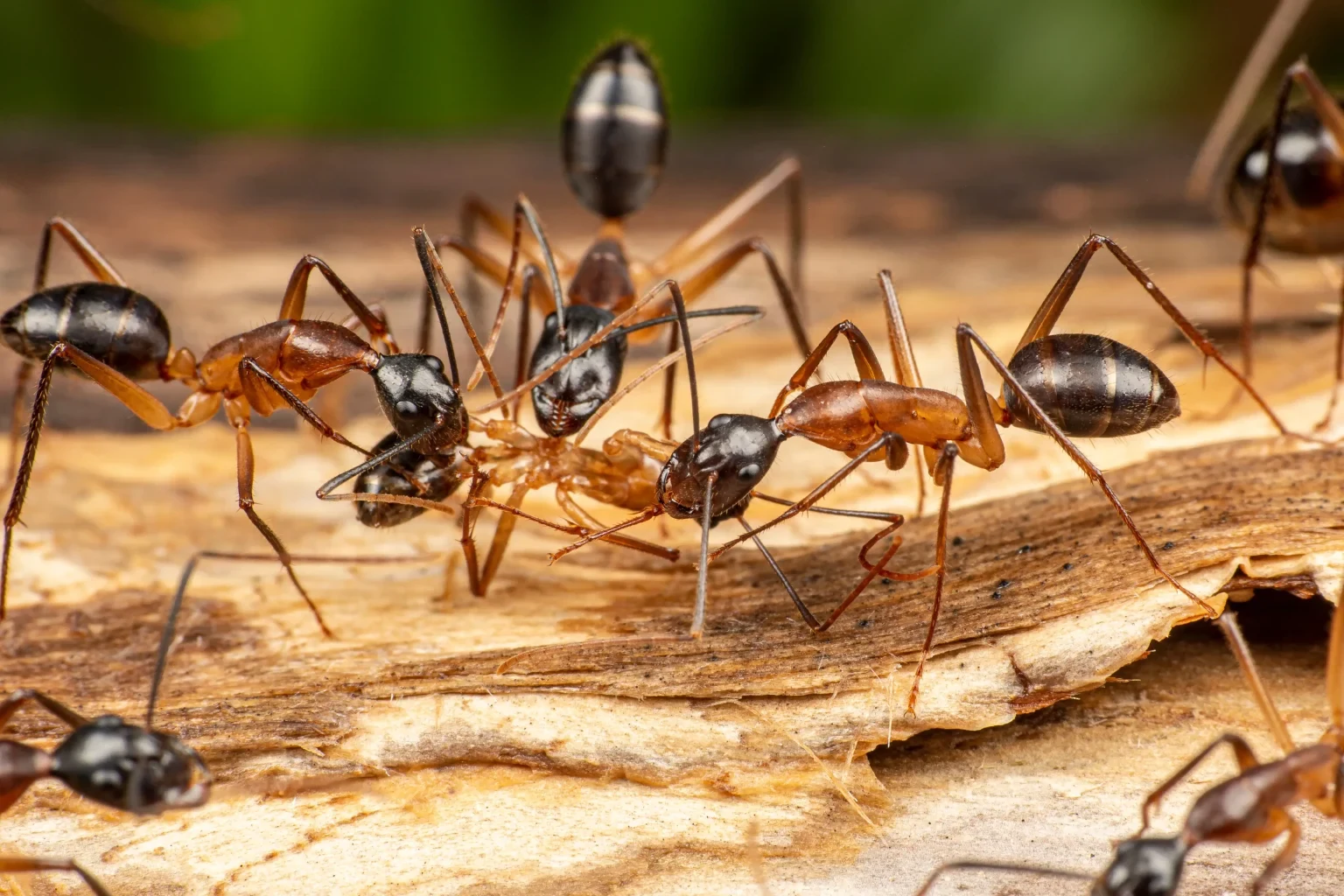 Carpenter ants • Camponotus

What's going on
The ant that hollows wood but never eats it
Carpenter ants are large social ants that build their nests inside wood. They chew out smooth galleries and push the shavings back out, but here is the key difference from a termite: they cannot digest wood. They are not feeding on your house or your tree, they are just moving in.
Because they excavate rather than eat, they almost always settle into wood that is already wet, rotting, or previously worked by termites. That is why finding them matters less as a bug problem and more as a signal: somewhere nearby there is a moisture or decay issue that made the wood soft enough to tunnel.
Camponotus species. Workers roughly one quarter to five eighths of an inch; winged reproductives up to three quarters of an inch. Yellowish-red, solid black, or a black-and-red mix.
Get the ID right first
Carpenter ant or termite?
In Central Texas both can throw off winged swarmers at the same time of year, and they get mistaken for each other constantly. Three features tell them apart every time, and getting it right decides the entire treatment plan.
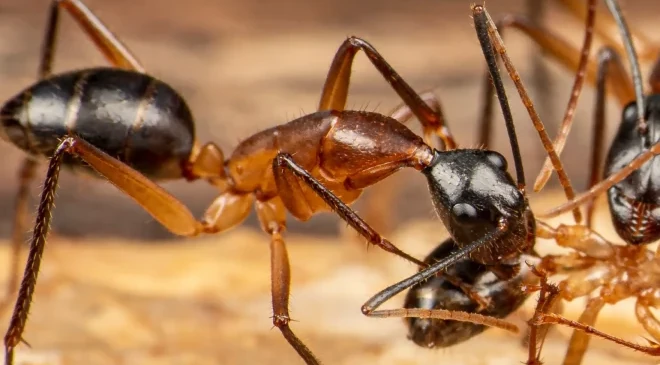 Carpenter ant • Camponotus
Carpenter ant
- Pinched, wasp-like waist with a single narrow node between thorax and abdomen
- Elbowed antennae, bent at a right angle about mid-length
- If winged, front wings clearly longer than the hind pair, and tinted
- An evenly rounded thorax with no spines or bumps, seen from the side
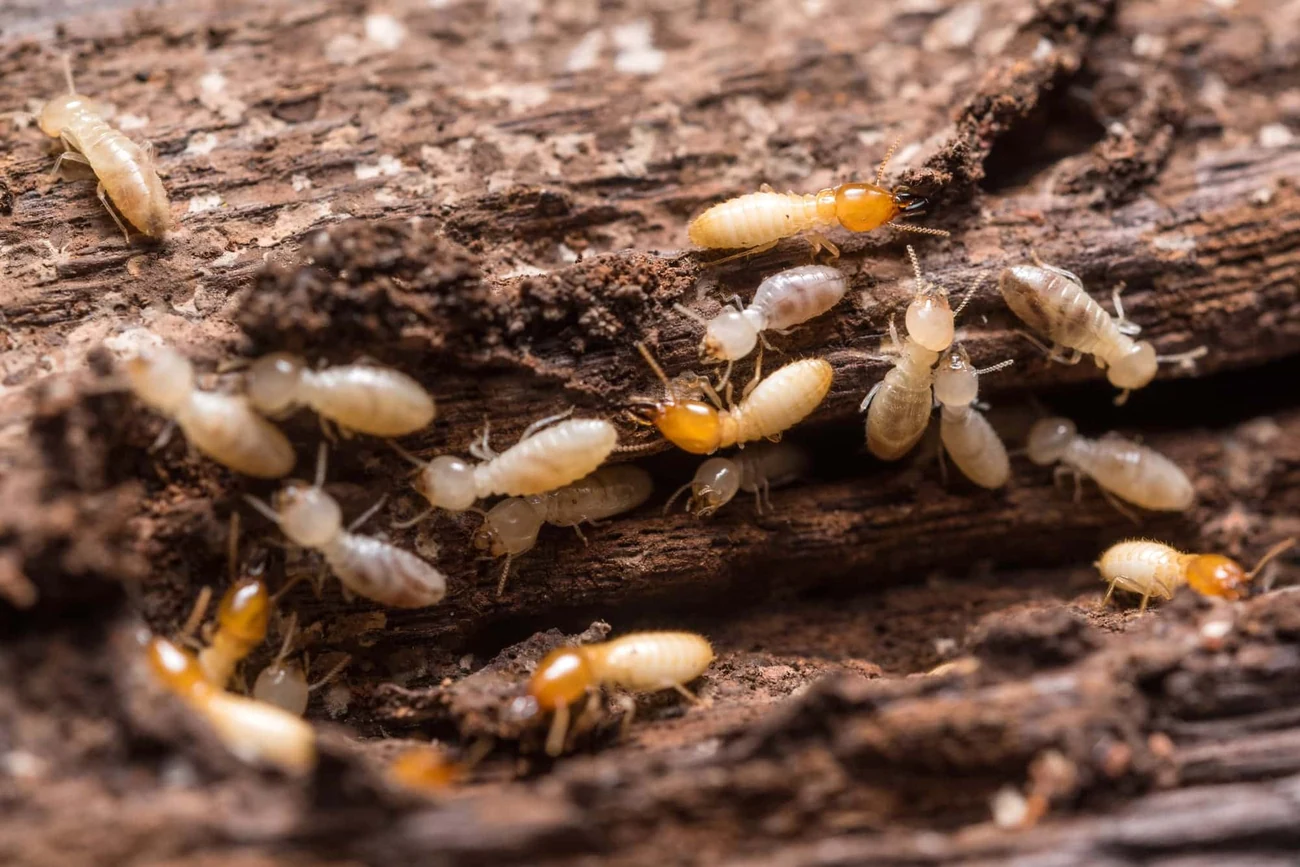 Subterranean termites
Termite
- Broad waist, the body joined thickly with no pinch, straight-sided
- Straight, bead-like antennae, no elbow
- Four wings all the same length, milky and easily shed
- Actually digests wood cellulose, so it is the one that does structural feeding damage
Two more things to know
A smaller look-alike, and the tell-tale pile
Even once you have ruled out termites, one other ant gets confused for the carpenter ant, and there is a giveaway that points you straight to a hidden nest.
The acrobat ant
Also nests in dead wood and gets mistaken for a carpenter ant, but it is smaller, an eighth to three eighths of an inch, and its abdomen is heart-shaped, often held up over its back. Not a wood-destroying concern.
Frass, and the kick-hole
Carpenter ants keep clean galleries and shove the debris out a small opening, a "kick-hole." Below it builds a cone-shaped pile of shredded wood, insect parts, and sawdust-like frass. Find the pile and the nest is close.
How the galleries read
Carpenter ant tunnels follow the grain and are smooth and clean, sanded-looking inside. Termites, by contrast, often line their galleries with mud. It is another quick way to tell which insect you are dealing with.
Follow the water
The nest is wherever the wood got wet
Carpenter ants favor damp wood, so a nest is really a map of your moisture problems. In a home, the usual suspects are the same spots that stay wet.
- Wood soaked by clogged gutters, bad flashing, or a low porch pitch
- Leaking door and window frames, or the framing around them
- Around plumbing in kitchens and baths where slow leaks have soaked the wood
- Wood in contact with soil: porch supports, siding, stair risers
- Poorly ventilated attics, crawl spaces, cellars, and under porches
- Voids around tubs, showers, and hot tubs, and hollow porch columns
- Wall, attic, and crawl-space insulation, including rigid foam board
They slip inside through cracks around windows and foundations, through ducts, through attic vents, and, most relevant to a tree owner, wherever a branch or utility line touches the structure and hands them a bridge.
Once in, they forage mostly at night, following fence rails, garden edging, hoses, and tree limbs as highways between a nest and a food source, sometimes as far as 100 yards away. That is why the ants you see indoors may be nesting in a stump or a tree in the yard.
Field note: because moisture is the real cause, killing the ants without fixing the leak just invites the next colony. The durable fix is drying the wood out, not spraying it.
When carpenter ants are in a tree
Outdoors, carpenter ants are not serious pests. In a living tree they nest in wood that is already dead or decayed, in old wounds, knotholes, hollows, and crotch angles. They occasionally weaken a limb that was already damaged, but they do not kill a sound tree, and Texas species do far less damage than the ones up north.
What a colony does tell you is useful: it is a flag that there is interior decay or a cavity in that wood. And decay in a trunk or a big scaffold limb can be a structural risk, a limb or stem that could fail, long before the ants themselves are any threat. That is the real reason to pay attention. The ants are pointing at something worth looking into.
So if you are seeing carpenter ants streaming in and out of a tree, the right question is not "how do I kill the ants," it is "what is going on inside that wood?" That is a tree-risk question, and it is exactly what I assess.
The arborist's read
A nest is a decay signal, not a spray job
When I find carpenter ants in a tree, the ants are rarely the real story. The wood they moved into is.

Round gallery openings with a pale frass pile at the base mean a colony has hollowed out a pocket of wood. But the ants did not create that decay, they moved into it. The real story is the pocket of dead, punky wood in an otherwise standing tree, and whether it sits somewhere structural.
That is exactly the kind of thing I look at on site. Nest evidence like this is a reason to check the surrounding wood for decay and risk, not a reason to reach for a can of spray.
The colony's arc
Why the swarm shows up when it does
A carpenter ant colony is slow to start and then grows fast. Understanding its year explains both the spring swarm and why an occasional swarmer indoors is not automatically an emergency.
Field note: a spring swarm emerging from inside your house means an established nest is in the structure, worth acting on. Swarmers that simply flew in from outside are far less alarming. Where they came from is the whole question.
What actually helps
Fix the conditions, skip the wrong products
Most of what keeps carpenter ants away is moisture and clearance work, not chemistry. And several products people reach for simply do not work on Texas carpenter ants.
Do
- Correct the moisture first: leaking faucets, roof leaks, poor drainage. It is the root cause.
- Replace decayed or termite-damaged wood so there is nothing soft to tunnel.
- Keep soil clear of structural wood and give crawl spaces and attics good ventilation.
- Remove stumps, logs, and debris near the house, and store firewood well away from it.
- Trim branches that touch the structure, they double as an ant bridge and a moisture trap.
Skip
- Grocery-store ant baits. The general-purpose containerized baits are not effective on Texas carpenter ants.
- Boric acid dust as a carpenter ant fix, it does not control them.
- Treating for termites and assuming it covers ants. Different insect, different control entirely.
- Wood preservatives to kill the ants. Boron products slow decay but will not control ants, since ants do not eat the wood.
- Spraying a tree colony before anyone has checked what the decay inside that wood means.
A house infestation is a pest pro's job, not mine
I want to be clear about lanes. If carpenter ants are nesting in your home, the right call is a licensed pest control professional. They know the local species, can locate hidden nests, and have access to carpenter-ant-specific baits and injectable dusts that do the job, tools that are not sold for general consumer use. Given that Texas carpenter ants rarely cause serious structural damage, weigh the cost against the benefit, and do not feel pressured into an ongoing contract just for a few ants. A pending home sale is the one case that often justifies an aggressive effort, since they count as a potential wood-destroying organism.
Where I come in is the tree. If the ants are working a tree in your yard, or you want to know whether the decay they are advertising is a hazard to your house, your car, or the people underneath, that is a tree-risk assessment, and it is what I do.
Carpenter ants in a tree? Let's find out what's inside the wood
Send me a photo of the ants and the tree, and I will help you tell a carpenter ant from a termite, read whether it points to decay worth assessing, and steer you to a pest professional if the real problem is in the house.
This page is educational and does not diagnose any specific tree or structure. Carpenter ant identification and structural pest treatment for buildings are the province of a licensed pest control professional; this guidance covers the tree side and the decay a colony can signal. Any pesticide use should follow the product label and local regulations. Insect facts here draw on Texas A&M AgriLife Extension guidance (publication E-412, Carpenter Ants).